Approvals
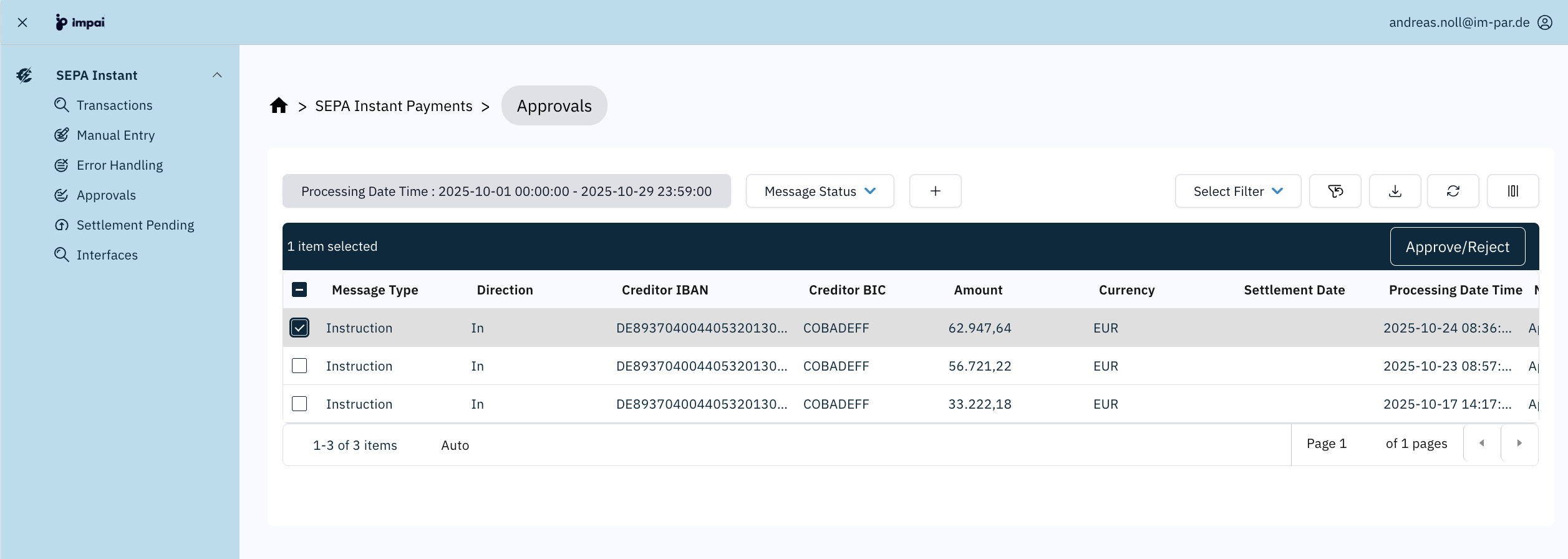
The Approvals screen provides a consolidated view of all transactions waiting for approval by a user. It allows users to monitor to review and approve or reject pending transactions, check transaction details, and approve or reject transactions.
See 👉 Working with Table Views for shared controls in the screen.
Key Features
-
Generic Search
- Displays all transactions within the selected Processing Date Time range and further criteria.
- You can further refine the view by applying filters (e.g., Status, Direction, Global Id).
-
Transaction Details
- See the full details of each transaction listed.
- Display the payment data.
- Display processing information for monitoring and resolution reasons.
Generic Search
Each row in the approvals table represents a single transaction entry.
The list displays instructions and other types of transactions, making it the central point for monitoring pending approvals.
A Processing Date Time range filter at the top defines which transactions are displayed.
Additional filters are available for attributes such as amount, direction, creditor, status, and others.
Details about filtering, saving, and loading filter sets are described in the section 👉 Filter Panel.
Table Columns
The set of columns displayed may vary depending on the screen type and the functional area you are working in. Each screen shows only the fields relevant to its purpose.
| Column | Description |
|---|---|
| Message Type | The message type associated with the transaction according to the used payment scheme (for example, Instruction or Return). |
| Direction | Indicates whether the transaction is In (incoming to ImPAI) or Out (outgoing from ImPAI). |
| Creditor IBAN | Account information of the payment receiver. |
| Creditor BIC | Bank information of the payment receiver. |
| Amount | Transaction amount in the original currency. |
| Currency | The payment's currency. |
| Settlement Date | The date when the payment was or will be settled. |
| Processing Date | Timestamp when the transaction was processed by the platform. |
| Message Status | More specific message-level state (for example, Settled, ApprovalPending, BookingFailed). |
| Global Id | Acts as a thread identifier, linking all subsequent messages. |
| Transaction Id | The key identifier for the transaction over all involved parties. |
| Internal Id | A unique system-level reference for the message. |
| Message Version | The exact ISO20022 message version used. |
| Creditor Name¹ | Name of the payment receiver. |
| Debtor BIC¹ | Bank information of the payment sender. |
| Debtor IBAN¹ | Account information of the payment sender. |
| Debtor Name¹ | Name of the payment sender. |
| External Id¹ | An additional external identifier for the transaction. |
¹ These columns are hidden by default.
All columns can be made visible or hidden depending on the selection of the user. Click on the  Column Settings button to make your choice.
Actions and Interaction
| Action | Description |
|---|---|
| Double-click a row | Opens the Approvals Details screen (see the corresponding chapter). |
| Approve / Reject | Allows to approve or reject the selected transaction manually. |
| Refresh | Reloads the transaction data with the current filter settings. |
| Save / Load Filter Set | Stores the currently applied filters or reloads a saved configuration. |
| Clear Filters | Resets all filter criteria to default values. |
Related Topics
Approvals Details
In the Approvals Detail view both high-level status and full payment information are displayed. This allows a deep understanding of the current status of the payment and its background.
What You See in Approvals Details
You will find three main areas at the screen.
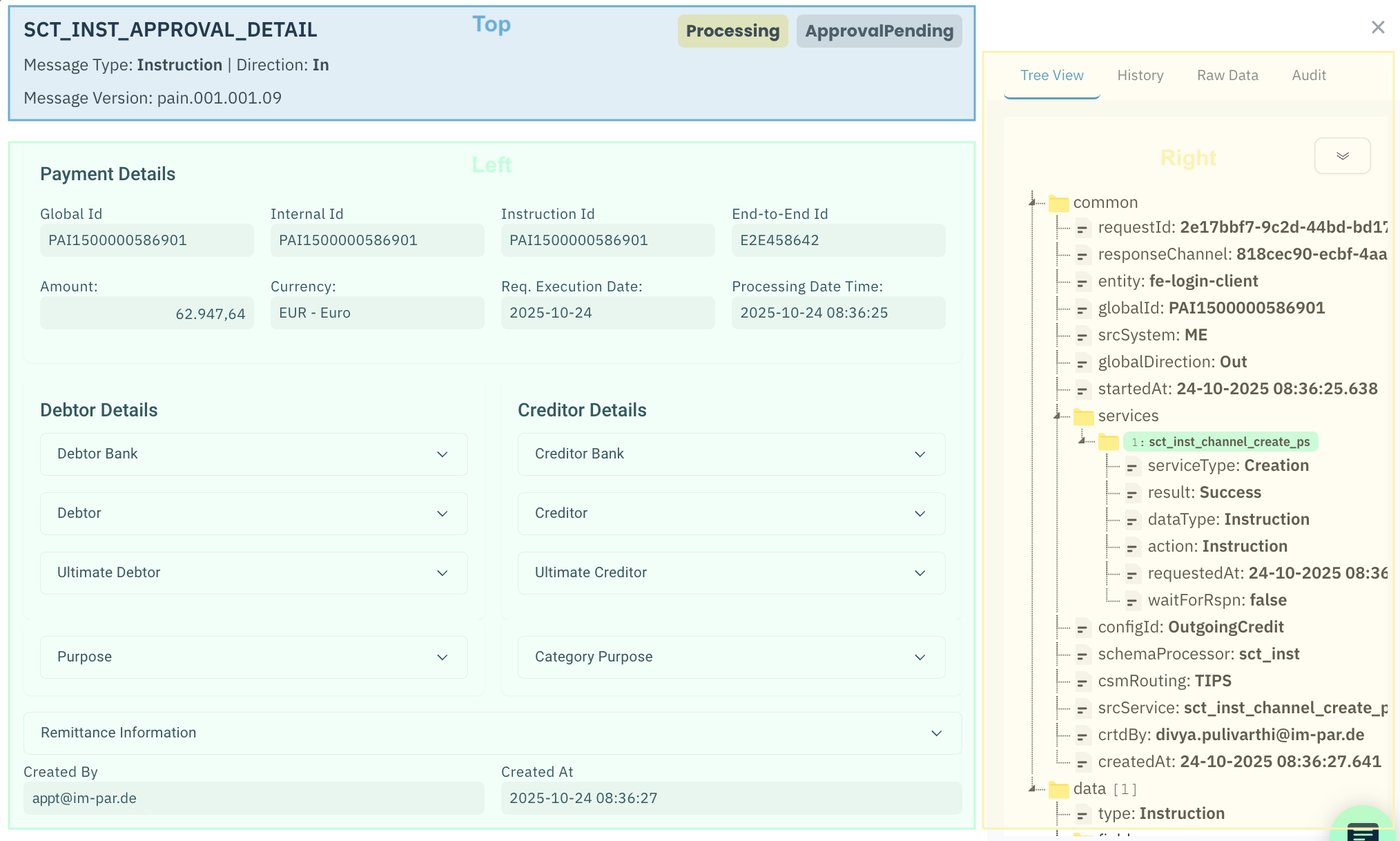
Top Area
This area on the top shows some high level information of the payment:
- Transaction Status – i.e., PROCESSING.
- Message Status – i.e., APPROVALPENDING.
- Message Type – type of payment message, such as Instruction (pain.001), Return (pacs.004), etc.
- Direction – whether the message is Incoming or Outgoing.
- Message Version – ISO 20022 version (e.g., pacs.001.001.09).
Below, the screen is divided into two main parts:
Payment Area
This area on the left shows the business data (transaction and party information) of the payment:
- Payment Details – Global Id, Internal Id, Transaction Id, End-to-End Id, Amount, Currency, Settlement Date, Processing Date Time.
- Debtor Details – Debtor bank (IBAN, BIC), Debtor name, optional identification and address.
- Creditor Details – Creditor bank (IBAN, BIC), Creditor name, optional identification and address.
Processing Area
This area on the right contains tools for deeper analysis offering additional technical and message views:
- Tree View – hierarchical breakdown of the message content.
- History – timeline of the transaction lifecycle (e.g., instruction created, sent to ACH, response received).
- Raw Data – full ISO 20022 message in original format.
- Audit Data – system-level metadata such as request Ids, timestamps, and response channels.
- Use the top area for a quick overview of status and message type.
- Use the payment area when answering operational questions (who paid, how much, when settled).
- Use the processing area for investigations and technical checks (raw message content, ACH responses, validation results).
Payment Area
Opening Approvals Details
To see the full details of a transaction, you need to double-click on any row you would like to get additional information about in the Approvals screen. This opens the Approvals Detail view, giving you a comprehensive overview of the payment.
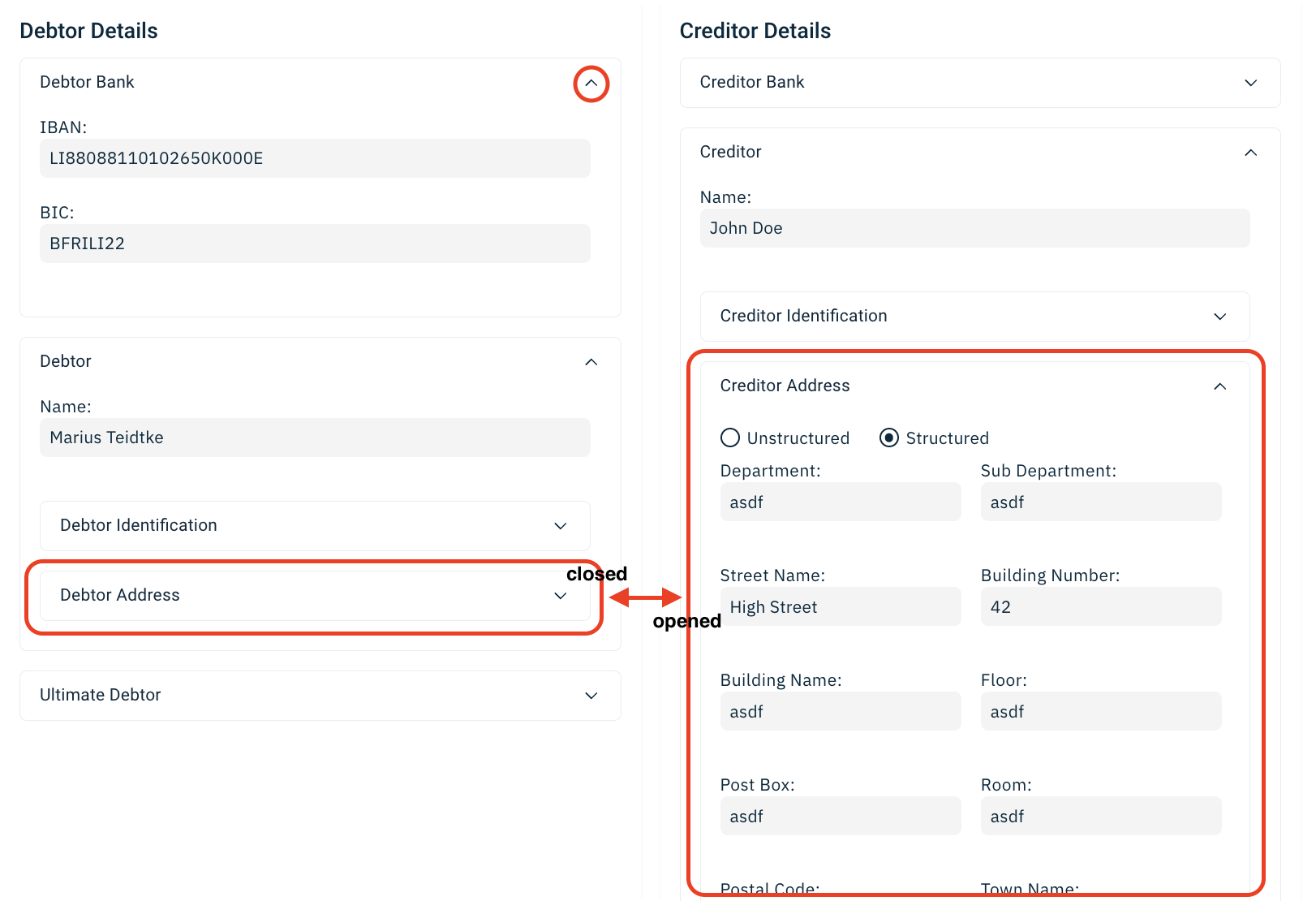
Expanding and Collapsing Party Information
In the Payment Details area, the Debtor and Creditor Details sections are designed to be expandable. This helps you focus only on the information you need.
How it Works
- Each subsection (e.g., Debtor Bank, Debtor, Debtor Identification, Debtor Address, etc.) has a collapse/expand toggle (
 ,
,  ).
). - By default, key details like Name, IBAN, and BIC are visible.
- Additional details, such as identification or structured address fields, can be revealed by expanding the section.
Closing Approvals Details
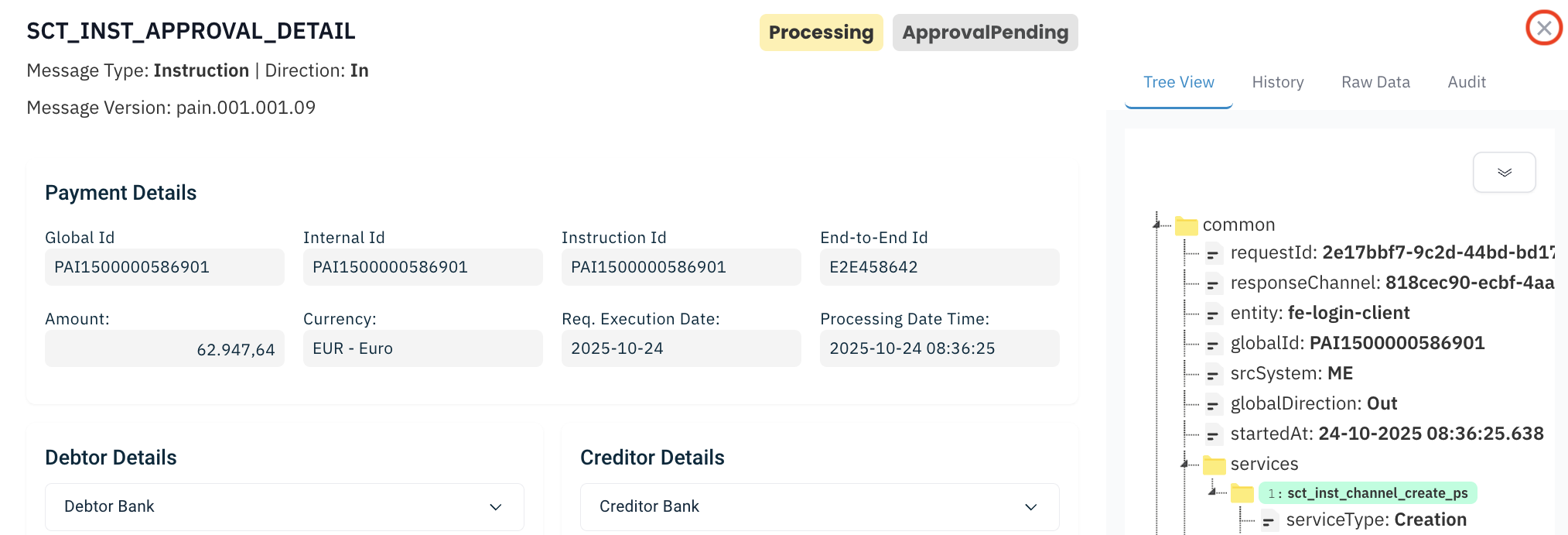
In order to close this detail screen again, you need to click on the cross in the uppermost right corner of the screen. You will come back to the Approvals screen from where you opened the Approvals Details screen.
Processing Area
Tree View
The Tree View tab on the right panel in the Approvals Detail screen provides a structured breakdown of the payment’s lifecycle and technical processing steps.
What You See
- The Tree View is organized into expandable folders, similar to a file explorer.
- Clicking on the double arrow icon in the top right corner of the Tree View expands or collapses all folders at the same time.
- Each folder represents a service or processing step that the transaction passed through.
- Additionally, it presents the actual message data in a structured way.
Find the full description of this area under 👉 Transactions ➞ Processing Area.
Approval Actions
The Approval screen allows users to review and authorize payments before they continue through processing.
Depending on user roles and permissions.
To open the Approval screen you have to:
- Select one row by ticking its checkbox
- Click on the Approve/Reject button
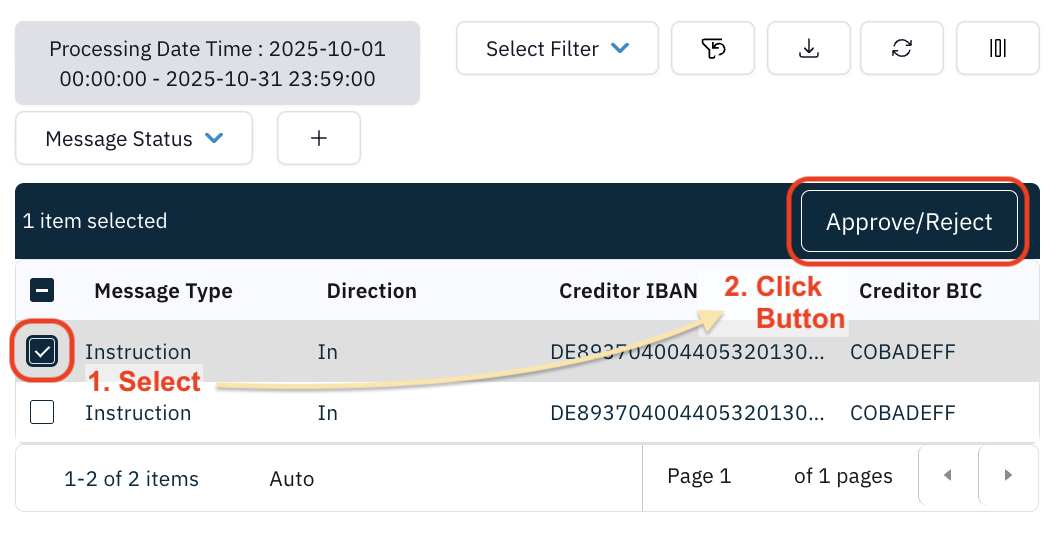
Clicking the button opens the Approval screen for the selected transaction:
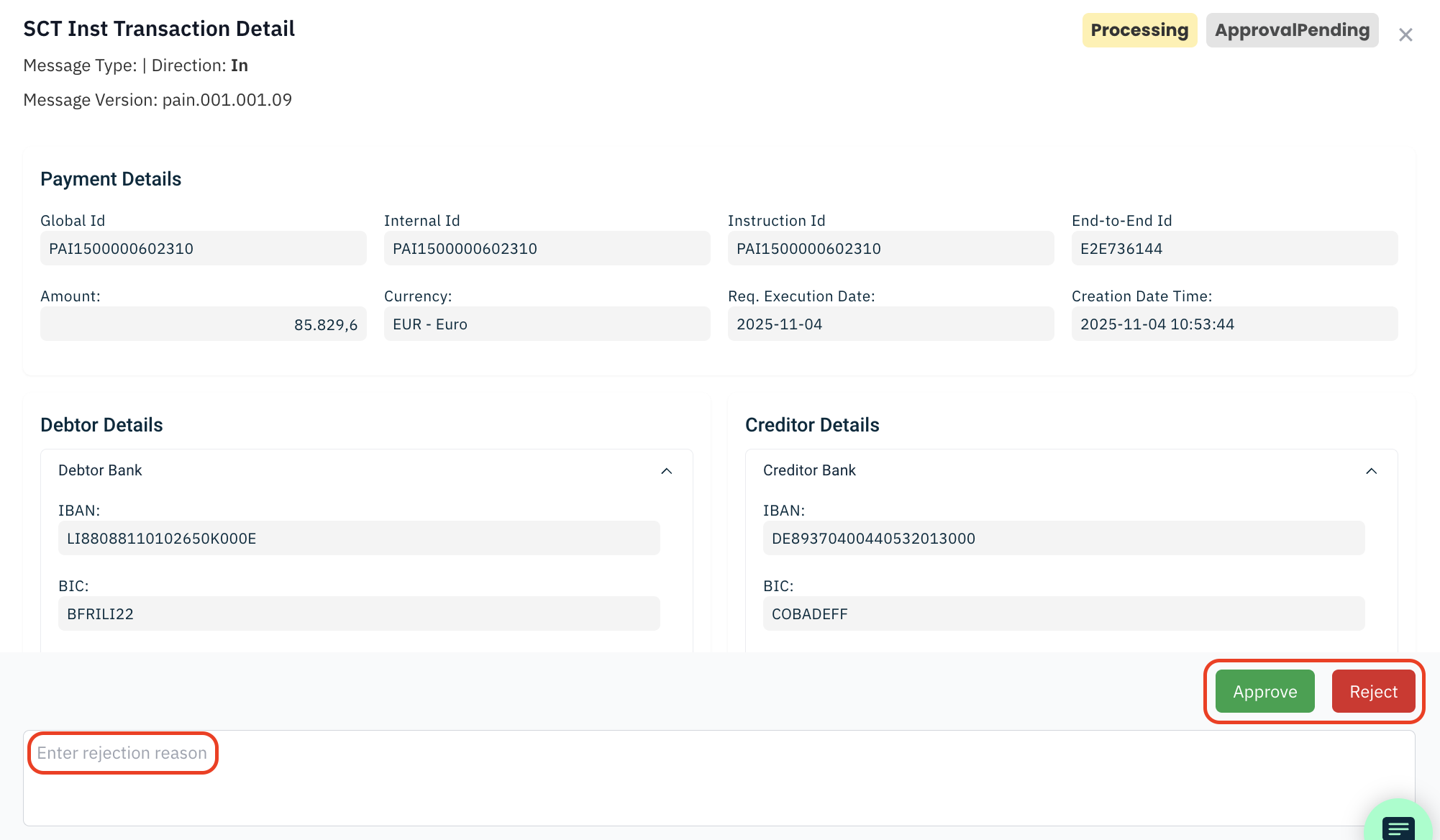
From here the following actions are available:
Approve
Clicking the Approve button confirms the transaction and allows further processing, such as clearing and settlement.
- Once approved, the item is removed from the approval queue.
- Status and state values are updated accordingly.
Reject
Clicking the Reject button stops the transaction from continuing in the process flow.
- A comment may be required to document the reason for rejection.
- The transaction may appear later in Error Handling or be fully terminated, depending on business rules.
Enter Rejection Reason
Additional context can be provided in the box below the buttons to support the approval decision.
Comments improve traceability and assist downstream operational handling.
To View the Audit Trail just open the Approvals Details by double-clicking the row in the table and check the content of the Tree View and the Audit tabs in the Processing Area to monitor:
- Actions performed on the transaction
- System events and status changes
- Who approved or rejected and when
This supports compliance and accountability.
Typical Workflow
- Load the “My high-value approvals” filter preset to focus on transactions that meet your threshold or risk criteria.
- Select a transaction and review its details, including amount, debtor/creditor information, and any attached comments or audit history.
- Based on the review, choose Approve to continue processing, or Reject to stop the transaction and (if required) provide a reason.
See 👉 Working with Table Views for shared functionality.