Interfaces
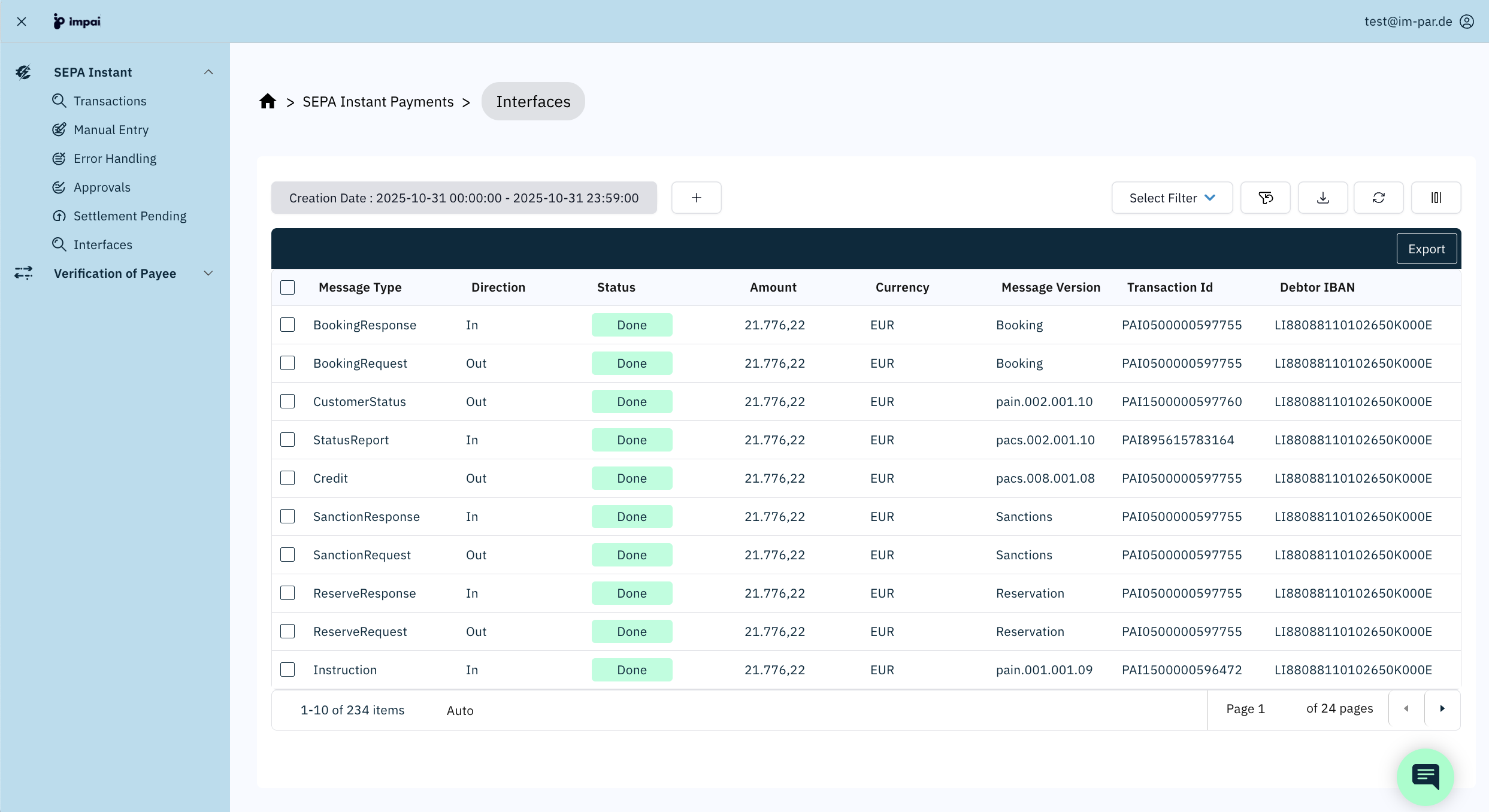
The Interfaces screen provides a consolidated view of all inbound and outbound messages exchanged through system interfaces or connections. It allows users to monitor the message traffic, check detail information, and export message data for reporting or analysis.
See 👉 Working with Table Views for shared controls.
Key Features
-
Generic Search
- Displays all messages within the selected Creation Date and further criteria.
- You can further refine the view by applying filters (e.g., Status, Direction, Creditor IBAN, etc.).
- Depending on the kind of message the available data may vary.
-
Communication Tracking
- Displays every single inbound and outbound message sent between ImPAI and any bank and external system.
- This includes booking or reservation requests and responses (and similar messages) as well as messages exchanged with an ACH.
-
Message Details
- See the full details of each message listed.
- Display the message data.
- Display processing information for monitoring and resolution reasons.
Generic Search
Each row in the interfaces table represents a single message exchange.
The list displays both successfully processed and failed transactions, making it the central point for reviewing the current and past processing results.
A Creation Date range filter at the top defines which messages are displayed.
Additional filters are available for attributes such as amount, direction, creditor, status, and others.
Details about filtering, saving, and loading filter sets are described in the section 👉 Filter Panel.
Table Columns
The set of columns displayed may vary depending on the functional area you are working in.
| Column | Description |
|---|---|
| Message Type | The message type associated with the transaction according to the used payment scheme (for example, Credit or Instruction). |
| Direction | Indicates whether the transaction is In (incoming to ImPAI) or Out (outgoing from ImPAI). |
| Status | High-level processing status (for example, Booked, Error, Processing). Color-coded for quick recognition: 🟢 Green – successfully processed 🔴 Red – timeout or failure detected 🟡 Yellow – In progress ⚪️ Gray – Processing not started. |
| Amount | Transaction amount in the original currency. |
| Currency | The payment's currency. |
| Message Version | The exact ISO20022 message version used. |
| Transaction Id | The key identifier for the transaction over all involved parties. |
| Debtor IBAN | Account information of the payment sender. |
| Creditor IBAN | Account information of the payment receiver. |
| Global Id | Acts as a thread identifier, linking all subsequent messages. |
| Internal Id | A unique system-level reference for the message. |
| Creation Date | Timestamp when the message was created by the platform. |
| Debtor BIC | Bank information of the payment sender. |
| Creditor BIC | Bank information of the payment receiver. |
| Debtor Name¹ | Name of the payment sender. |
| Creditor Name¹ | Name of the payment receiver. |
| Instruction Id¹ | The unique identifier for an (underlying) instruction. |
| Interface Type¹ | The type of the interface, like Connection, Backoffice, etc. |
| Settlement Date¹ | The date when the payment was or will be settled. |
¹ These columns are hidden by default.
All columns can be made visible or hidden depending on the selection of the user. Click on the  Column Settings button to make your choice.
Interface Details
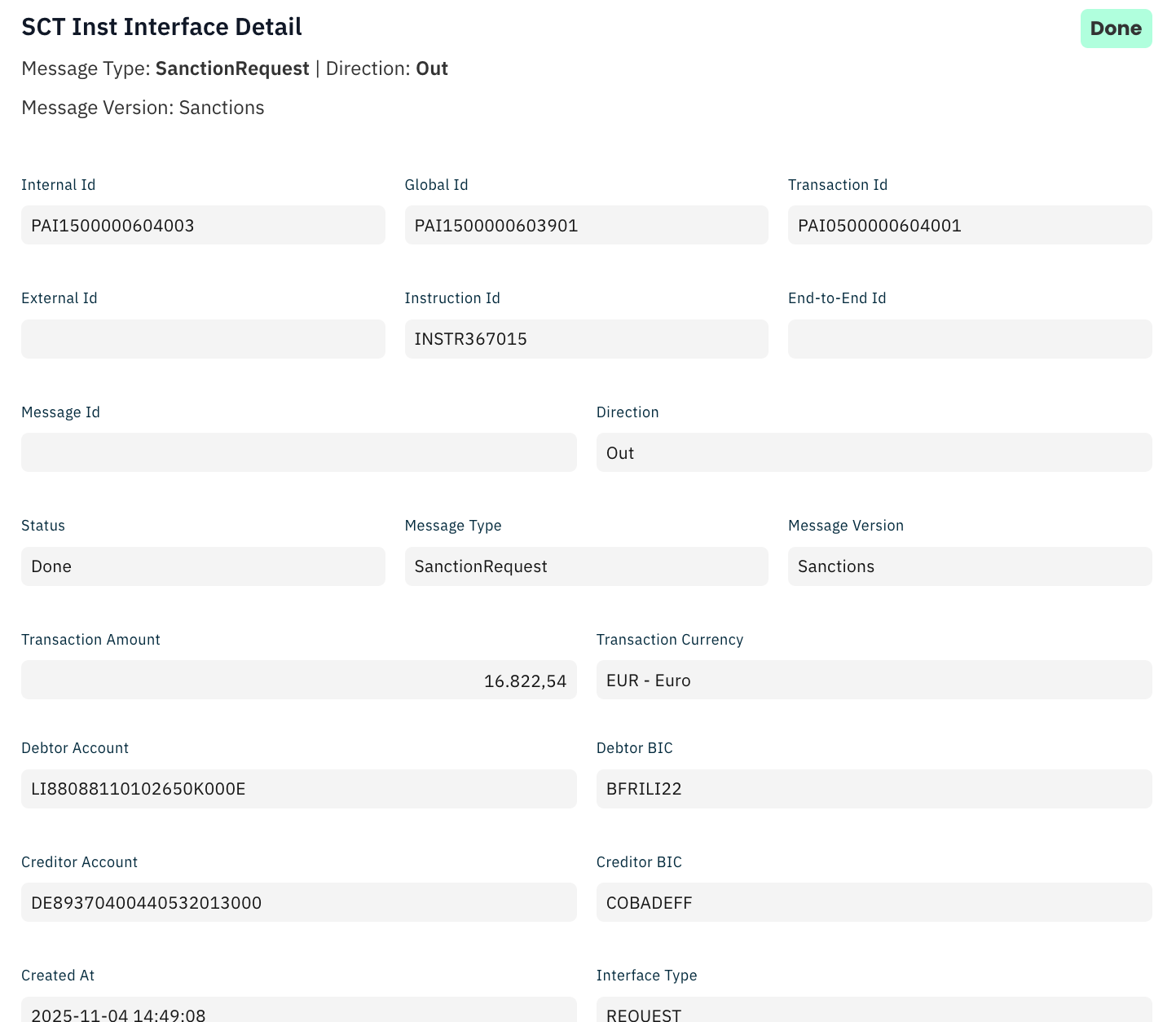
In the Interface Detail view the detail status and relevant message information are displayed. This allows a deep understanding of the current status of the single message and allows to track the lifecycle of a transaction step-by-step.
What You See in Interface Details
You will find three main areas at the screen.
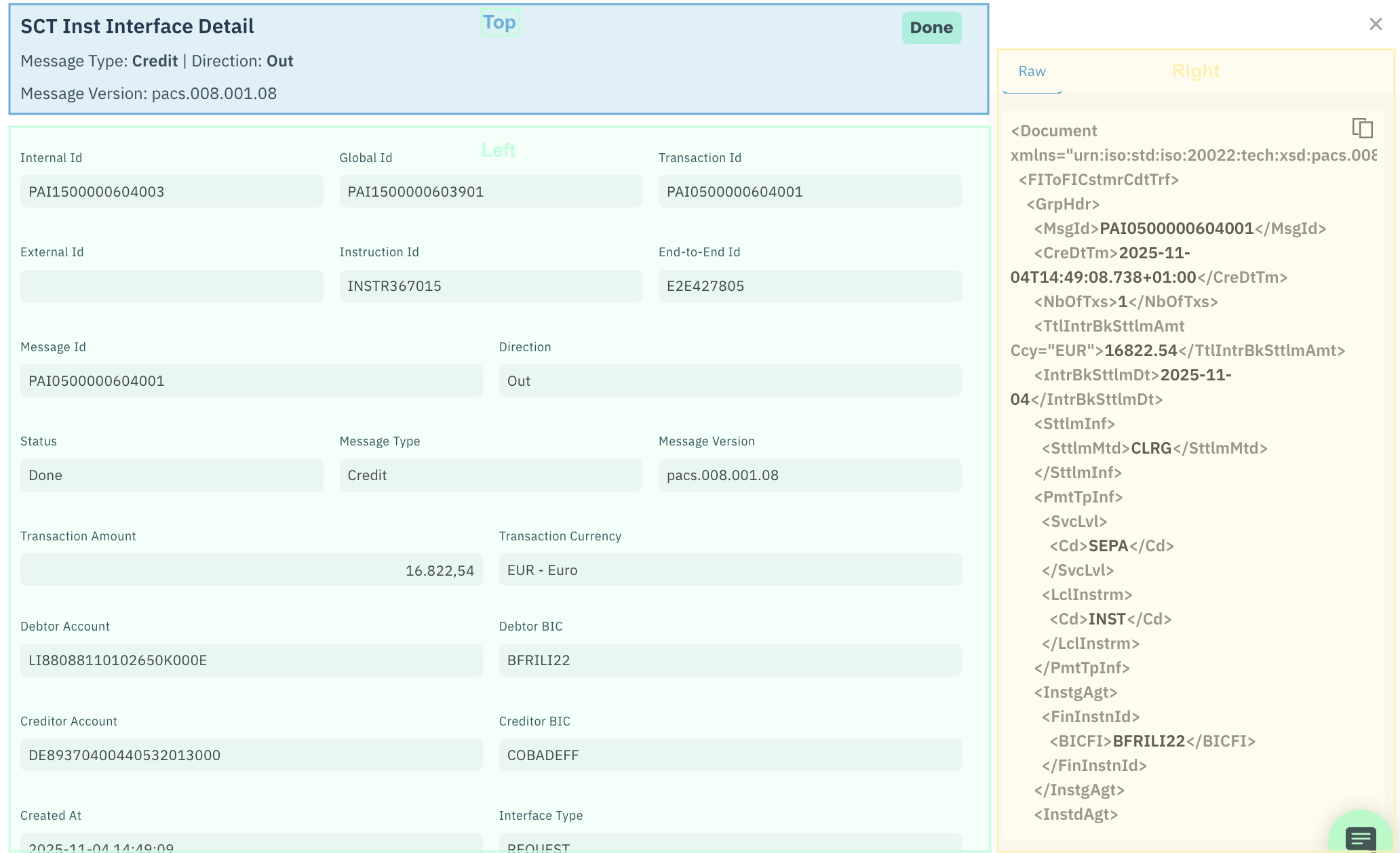
Top Area
This area on the top shows some high level information of the message:
- Message Status – i.e., NEW, DONE.
- Message Type – type of message, such as Instruction (pain.001), Booking, ReservationResponse etc.
- Direction – whether the message is Incoming to ImPAI or Outgoing from ImPAI.
- Message Version – ISO 20022 version (e.g., pacs.001.001.09, Booking).
Below, the screen is divided into two main parts:
Message Area
This area on the left shows the business data (meta and party information) of the message:
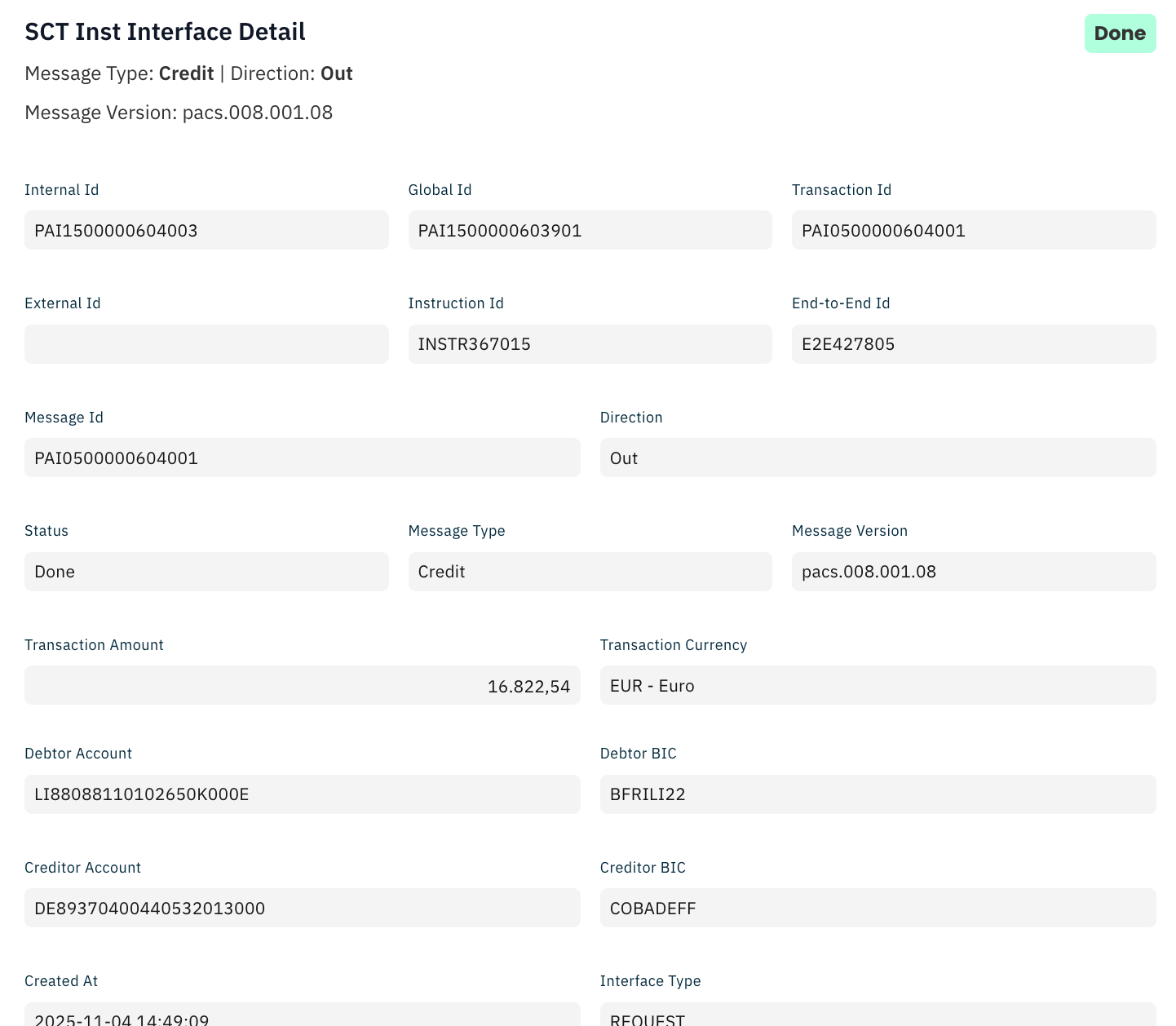
- Message Details – Global Id, Internal Id, Transaction Id, End-to-End Id, Amount, Currency, Processing Date Time, as far as available.
- Debtor Details – Basic information about debtor bank (IBAN, BIC) and debtor name, if available.
- Creditor Details – Basic information about creditor bank (IBAN, BIC) and creditor name, if available.
Processing Area
This area on the right contains tools for deeper analysis offering additional technical and message views:
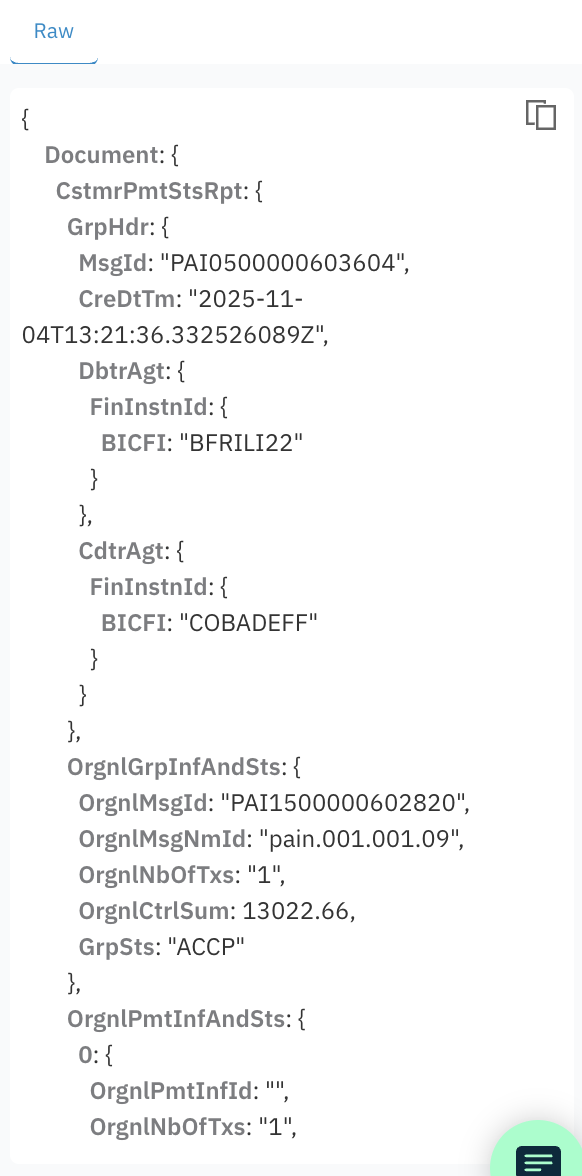
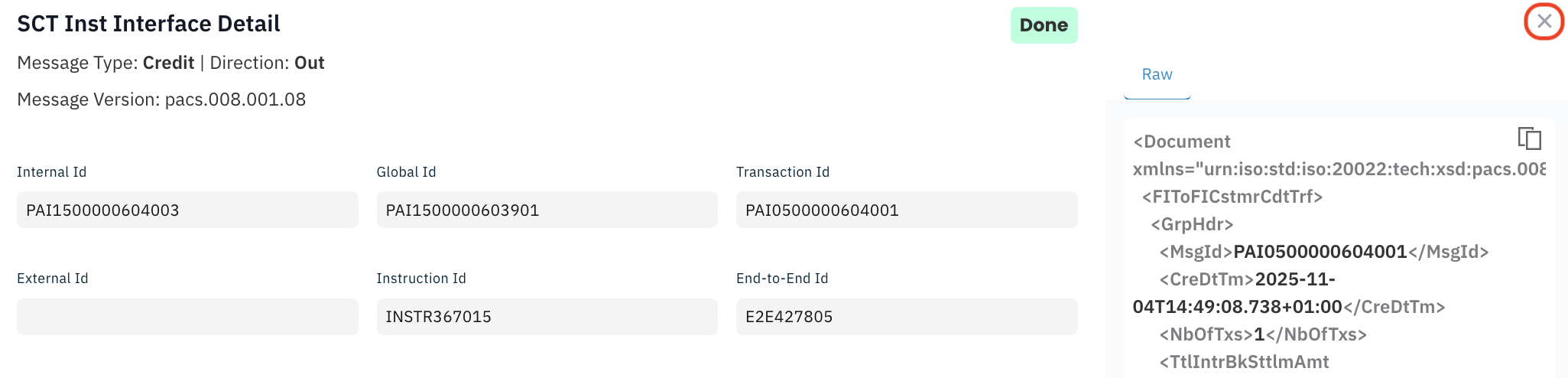
- Raw Data – full message sent or received in its proprietory and original format.
- Use the top area for a quick overview of status and message type.
- Use the payment area when answering operational questions (what is the prupose of the message? Which data was used?).
- Use the processing area for investigations and technical checks (raw message content).
Message Area
Opening Interface Details
To see the full details of a message, you need to double-click on any row you would like to get additional information about in the Interfaces screen. This opens the Interface Detail view, giving you a comprehensive overview of the message.
Regardless of the actual message type, the screen always display the same set of information. Depending on the availability of the data some of the fields maybe left empty for certain messages.
Example: Interface Details for a Credit Message
Example: Interface Details for a Sanction Request
Closing Interface Details
In order to close this detail screen again, you need to click on the cross in the uppermost right corner of the screen. You will come back to the Interfaces screen from where you opened the Interface Details screen.
Processing Area
Raw Data
In the Raw Data tab on the right side of the screen you can find the full message sent or received in its original format (e.g., XML, JSON, ISO20022, any proprietary format, …). You may click on the copy icon (⧉) in the upper right corner to copy the full set of data into the clipboard.